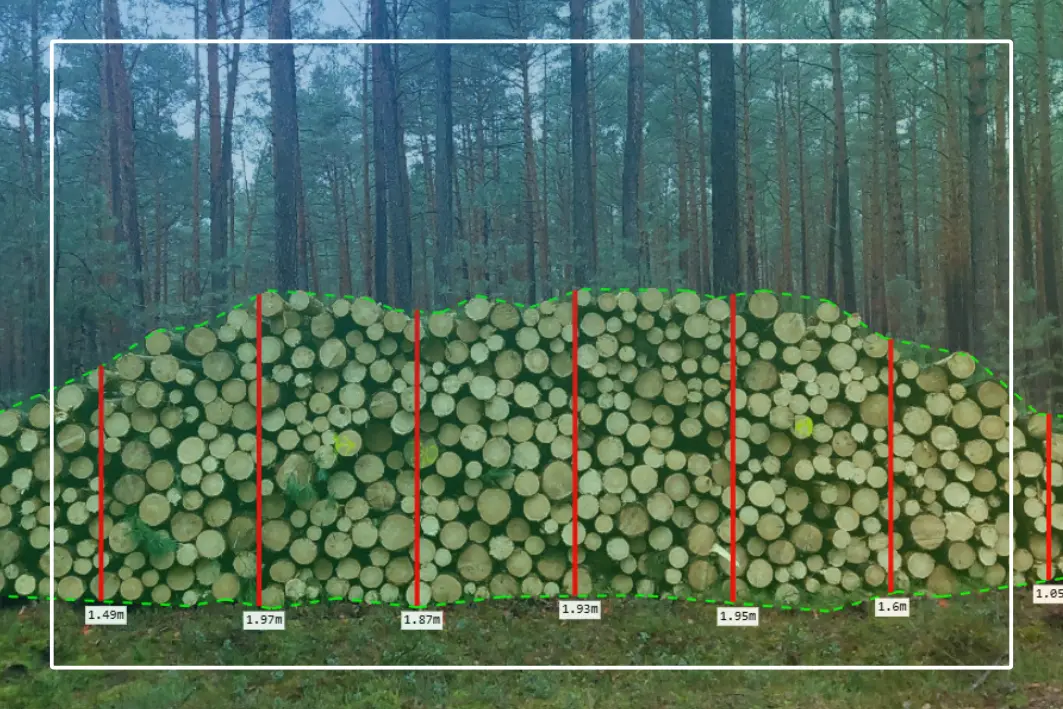
In an industry where every cubic metre of timber counts, measurement accuracy can make or break margins—and sustainability goals. For forestry and timber-trade professionals, transitioning to digital timber measurement isn’t just a convenience: it’s a strategic imperative. Fortunately, with Timbeter’s AI-driven photo-optical system, you’re no longer sacrificing reliability for speed.
Why accurate digital timber measurement matters
Traditional timber measurement—using tapes, tables, and manual estimation—is slow, error-prone, and often lacks transparency. As forestry embraces digital technology, precision has become essential for fair trade, traceability, and sustainable logging. With Timbeter’s digital tools, organisations achieve faster, more reliable measurements and maintain transparent data for compliance and sustainability.
Timbeter’s Accuracy: Independent Research & Certification
Timbeter’s digital timber measurement credentials are robust. Here are the highlights of independent testing and certifications validating its performance:
• Metrosert AS (Tallinn, 2015)
In Report BTLL-15/0036, Metrosert evaluated Timbeter 3.0 for geometric surface and log-pile measurement at 4-8 m distance using an Android tablet. The relative expanded uncertainty ranged from 0.58 % to 2.10 %, aligning with EA-4/02 guidelines.
• CESMEC SA (Chile, 2020)
Under Certificate SML-24160, 116 industrial pine logs were measured. Timbeter’s deviations ranged from –0.47 m³ to +0.73 m³ (≈ ±1-2 %) compared to manual accredited lab measurements—demonstrating strong commercial-scale accuracy
Academic studies (2022-2024)
- A Warsaw University study compared manual, photo-optical and laser methods on broadleaf log piles (193.7 m³). The photo-optical method (including Timbeter) achieved +1.34 % / –1.83 %.
- Metrosert’s 2023 calibration certificate KTLL-23/2626 showed relative deviations between 1.29 % and 2.28 % under calibrated conditions (simulated piles).
- Further field tests by the University of Agriculture in Kraków (2024) found measurement differences around ~1.5 % and time-savings up to 89 %.
- At the Latvia University of Life Sciences and Technologies (LLU) thesis (2024) deviations of –2.46 % for individual logs and –1.72 % for stacks were recorded.
- A Turkey study (2024) with 21 log stacks found no significant difference (p > 0.05) and average error under 3 %.
In short: under trained users and good conditions, Timbeter’s accuracy meets the ±1-3 % target—or better.
Practical Benefits for Forestry and Timber Logistics
Beyond the numbers, what does this mean for your business?
Faster workflows
Because measurement becomes as simple as photographing a log pile and letting AI compute volume, you can capture more data in less time—freeing field staff for other tasks.
More reliable data, more transparency
High-precision measurement helps you build trust across the supply chain—from contractors to buyers to regulators. All recorded in digital format: no paper-works and fewer disputes.
Sustainability & compliance
Accurate data ensures that harvested volumes align with plans, reducing risk of over-logging, misreporting or unsustainable practices. Moreover, reliable data is critical in markets with regulatory scrutiny over legality and origin of timber.
Data-driven decision making
With the cloud-based dashboard and analytics (see Timbeter’s dashboard features), you gain visibility into stock, logistics and trends—allowing sharper planning. Reference: Timbeter Dashboard blog.
Conclusion
In an era where forestry operations require speed, accuracy and sustainability, the digital timber measurement solution offered by Timbeter stands out. With independent verification of accuracy within ±1–3 % and comprehensive functionality, your organisation can measure timber volumes more reliably, reduce manual errors, and support sustainable logging practices. Ready to elevate your timber measurement process? Contact our team at Timbeter and start your digital transformation today.