A timber crew wraps up a harvest on a federal contract. The volumes look right on paper — scaling was done roadside, notes were taken by hand, and the load tickets match what the mill received. Then comes a legal challenge. An environmental group contests the scope of the harvest. Regulators ask for documentation. And suddenly, the informal records that worked fine for internal tracking are expected to stand up to outside scrutiny.
This scenario is playing out more frequently. A federal court in Oregon struck down a Forest Service policy in January 2026 that had allowed large-scale logging projects to bypass full environmental review. The Fix Our Forests Act is stalled in the Senate. The Trump administration is pushing for faster permitting while conservationists push back in court. Whether you agree with any particular side of these debates, one reality is emerging for operators working on public or mixed-ownership land: your measurement data is no longer just a logistics tool — it’s a compliance record.
The documentation gap most operations ignore
Most timber operations are run by professionals who know their craft. Experienced scalers, reliable haulers, well-established relationships with mills. But documentation practices often lag behind the operational reality.
Roadside log pile measurements are still frequently done by eye or with manual tallies. Assortment volumes may be tracked in spreadsheets that aren’t time-stamped, georeferenced, or independently verifiable. When a single load gets disputed — whether over volume, species mix, or harvest location — there’s rarely a clean audit trail to fall back on.
This isn’t a paperwork problem — it’s a trust problem. Regulators, buyers, and increasingly, the public, expect forestry operations to produce data that is traceable and verifiable. Manual records, however diligent, leave room for doubt.
What “verified measurement” actually means in practice
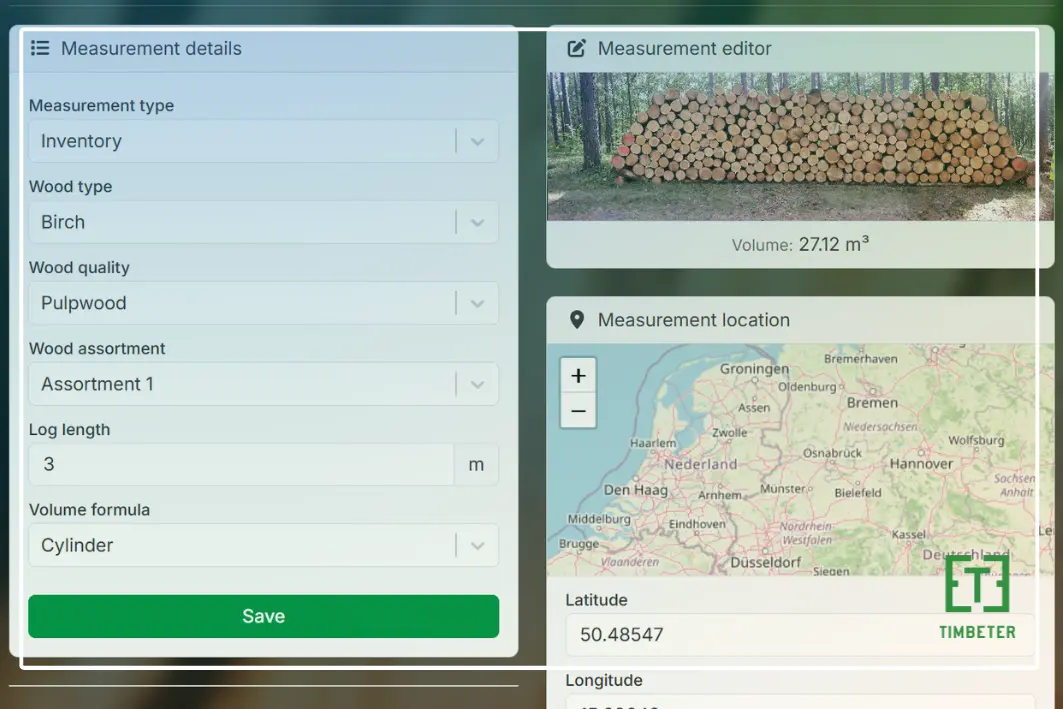
Verified measurement doesn’t mean more bureaucracy. It means that when a log pile is measured at roadside before loading, that measurement is captured with a timestamp, a GPS location, and a method that can be independently reviewed.
Timbeter’s mobile measurement platform does exactly this. A scaler photographs the log pile end face, and the app uses AI to count logs, calculate cross-sectional area, and generate a volume estimate — all tied to the time and place of capture. The result is a measurement record that doesn’t rely on memory or manual transcription. It can be exported, shared with a buyer or mill, or produced for a regulatory review.
For operations working under timber sale contracts on public land, this kind of documentation has moved from “nice to have” to genuinely necessary. A harvest that proceeds under challenged authorization needs to show not just that it was done, but how much was taken, from where, and how it was measured.
Fewer disputes, faster settlements
Scaling disputes are a routine friction point in timber logistics. A truck arrives at the mill short of the agreed volume. The buyer claims underdelivery; the seller stands by their roadside tally. Without an objective record from both ends of the chain, these disputes can drag on — and in a regulated environment, they attract attention neither party wants.
Consistent measurement practices dramatically reduce this friction. When every pile measured in the field generates a verifiable record, and those records align with what arrives at the mill, the paper trail closes itself. Discrepancies become detectable and explainable — not a matter of whose word you trust.
Transport optimization benefits from this too. When volumes are accurately known before loading, trucks are filled closer to capacity, partial loads become less common, and unnecessary return trips are avoided. Fewer trips for the same volume means less fuel, less road wear, and a smaller operational footprint — a practical sustainability benefit that also improves margin.
The broader shift: accountability is becoming table stakes
The legal battles over U.S. public lands logging aren’t going to resolve quickly. Whatever legislative or judicial outcomes follow, the direction of travel is clear: forestry operations are being held to a higher standard of documentation and transparency. That’s true whether you’re operating under a federal timber sale, a private contract, or supplying a mill with third-party certification requirements.
Investing in accurate, verifiable measurement now is straightforward risk management. It protects you in a dispute, supports compliance reporting, and signals to buyers and regulators alike that your operation runs on real data.
Your measurement data is now a compliance record — is it audit-ready?
Timbeter captures every log pile measurement with a GPS location, timestamp, and AI-verified volume — giving you a traceable record that holds up to regulatory review, buyer scrutiny, and scaling disputes.
Book Your Free Demo